

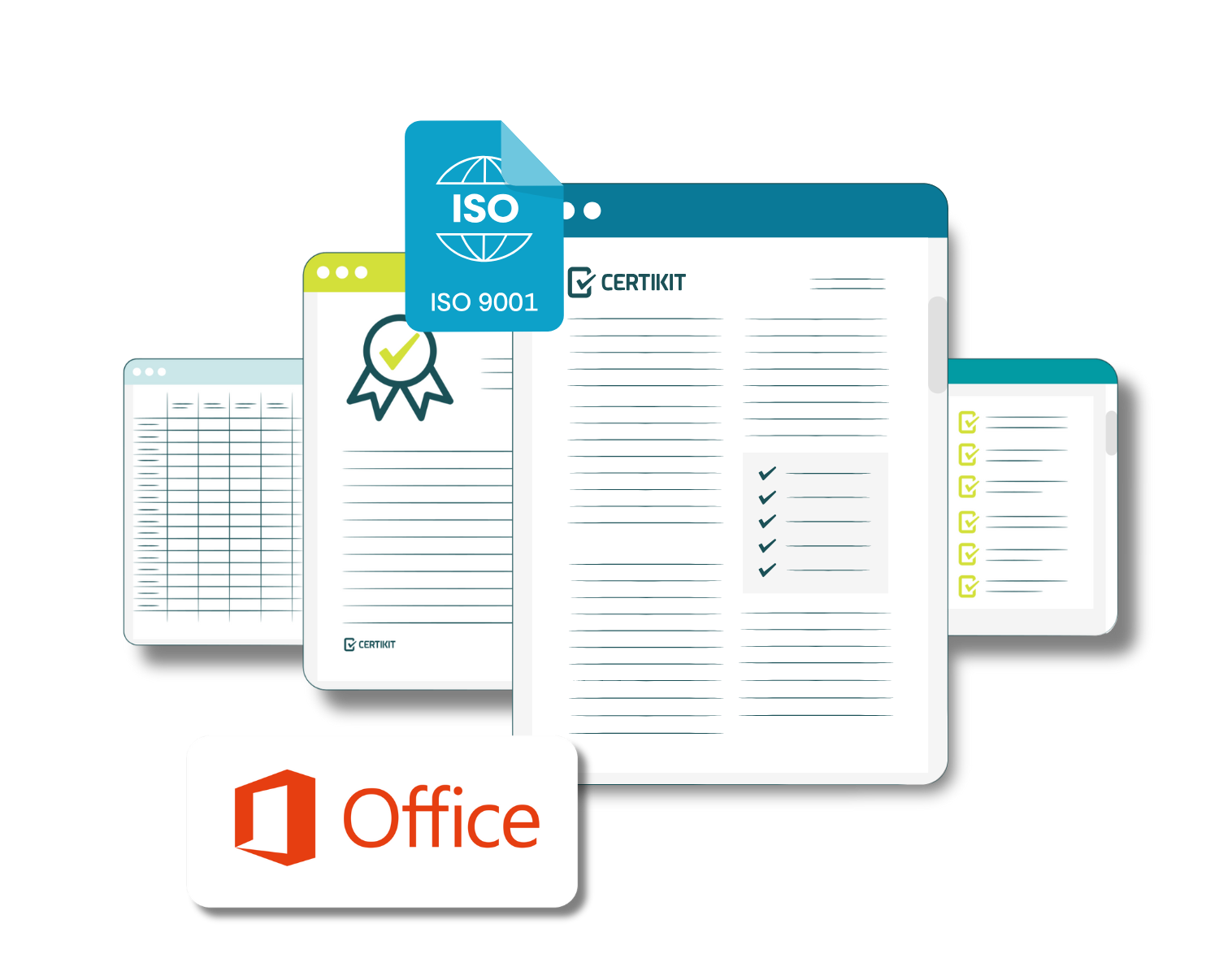
Yes, CertiKit is still retiring at the end of October, but that doesn’t mean we would leave without an update to our ISO9001 toolkit to match the 2026 version of this popular standard. The updated toolkit is now available to new customers to buy until 30th October, and to existing customers to download via their CertiKit account until 5pm UK time on Friday 18th December 2026. So don’t leave it too late or you’ll miss out!
In this blog we’ll look at what’s changed in both the standard and the toolkit.
What’s new in the 2026 standard
It’s worth spending a few minutes to understand the changes between the 2015 version and the 2026 version of the ISO9001 standard. It’s unlikely that anyone would claim the changes are big, but if you’re transitioning from a 2015-certified QMS to a 2026 one then there are a few adjustments you will need to make.
First, there are the heading changes. These have been introduced to make the ISO9001 standard more fully match the current definition of the Harmonized Structure. These changes are summarised in the following table.
OLD STRUCTURE | NEW STRUCTURE | COMMENTS |
4.4 Quality management system and its processes | 4.4 Quality management system | Reference to processes removed. |
5.2 Policy | 5.2 Quality policy | The word “Quality” has been added to the clause heading. |
5.3 Organizational roles, responsibilities and authorities | 5.3 Roles, responsibilities and authorities | The word “Organizational” has been dropped from the heading. |
6.1 Actions to address risks and opportunities | 6.1 Actions to address risks and opportunities 6.1.1 Determining risks and opportunities 6.1.2 Actions to address risks 6.1.3 Actions to address opportunities | Separate subclauses have been added. |
7.5.2 Creating and updating | 7.5.2 Creating and updating documented information | The heading has been expanded. |
9.2 Internal audit | 9.2 Internal audit 9.2.1 General 9.2.2 Internal audit programme | Separate subclauses have been added. |
10 Improvement 10.1 General 10.2 Nonconformity and corrective action 10.3 Continual improvement | 10 Improvement 10.1 Continual improvement 10.2 Nonconformity and corrective action | Headings have been reordered to match the Harmonized Structure. |
In many cases, the changes to the wording of the standard are designed to more explicitly emphasise points that were implied in the previous version. The standard now refers to itself as “this document” rather than “this International Standard”. Changes have also been made to clarify the meaning of places within the standard where documented information is mentioned, particularly the use of the new term “documented information shall be available” throughout the standard.
Within Clause 4 (Context) the requirement to consider climate change as an issue is now explicitly stated in the new version of the standard, rather than being an amendment. The need to identify which of the relevant requirements of interested parties will be addressed by the QMS is now included. The reference to processes is now part of a list rather than in the body of the text. There is now a need to make documented information available “as evidence that the processes are being carried out” rather than “to have confidence that the processes are being carried out” suggesting perhaps that some organisations didn’t need much evidence to inspire confidence about their processes previously.
The list in Clause 5 (Leadership) under General has been reordered and amended, with the idea of top management “taking accountability” being moved to the end and a requirement for “promoting quality culture and ethical behaviour” added somewhere in the middle.
The list of requirements of the Quality Policy has been reorganised with some points split into more than one, but with little obvious change in meaning.
In Clause 6 (Planning) the requirements for addressing risks and opportunities have been revamped and expanded somewhat, with the actions to address risks and opportunities being separated out, although the wording and meaning is still very similar in both cases. Planning of changes gains three new requirements around the communication, effectiveness and review of changes to the QMS, so these will need to be addressed.
Clause 7 (Support) has been subject to a revamp in terms of the order of many of the lists included, but with little discernible impact on requirements to be met. This may be more to do with alignment with the Annex SL harmonized structure than anything else.
Clause 8 (Operation) has similarly been reworded in many places, but with the goal of clarification and tidying up, rather than any significant change in meaning of the requirements.
The list of management review inputs in Clause 9 (Performance) has been amended and now explicitly includes the review of changes in the needs and expectations of interested parties that are relevant to the QMS.
The sub-clauses of Clause 10 (Improvement) have been amended to remove General in line with Annex SL and as a result the clause is now simpler and less wordy.
Lastly, Annex A has been updated provide more guidance about the interpretation of the standard and to reflect the above amendments to the requirements.
What’s new in the CertiKit ISO9001 toolkit
As you will gather from our run-through of the changes to the standard, this is not a major rewrite, despite much of the hype that has been flying about for over a year now in dark places like LinkedIn. However the changes do necessitate amendments to many documents to reflect the heading changes, reordering of lists and the odd new requirement. As a result, over sixty percent of the toolkit documents have changes to them, although in many cases these are small.
There are also five new documents:
· Certification Readiness Checklist
· QMS Processes and Interactions
· QMS Change Process
· QMS Change Log
· Quality Objectives and Planning Tool
We’ve updated the Implementation Guide to cover the changes to the standard, the toolkit and to the wider environment, such as the replacement of the IAF with GLOBAC for accreditation.
Both the toolkit Gap Assessment and the Enhanced Gap Assessment have been revamped to make them clearer, and the Project Plan has gained a Gantt chart and dashboard.
We’ve removed some content duplication between the Quality Policy and the Quality Manual and made the Context document more focussed on the requirements of Clause 4.
The Risk and Opportunity Assessment Process has been tailored to the new emphasis in the standard, and the Risk and Opportunity Assessment Tool now has a dashboard.
The Internal Audit Schedule has been replaced with an Excel-based tool and the Management Review Meeting Agenda now matches the changed list of inputs in the updated standard.
We’ve also corrected a number of minor errors, enhanced some tools to better match the requirements and tidied up some missing header pages.
More details on the updates to the toolkit are available in the Release Notes of the new toolkit version.
Our thoughts
As is usual with such standards there is a three year transition period starting from the date of publication of the new version, and there will be the inevitable delays while the auditing bodies position themselves to be able to audit to the new version. But I think it’s safe to characterise this update to the standard as more of a tidy up than a step change. In some ways that’s disappointing because I would have said that the world has changed in many ways since 2015 and the art of Quality might have changed with it. But on the positive side, it means that the hard-pressed Quality Manager has less to do for the transition than could have been the case. If your organisation is already certified, then it’s probably a good idea to give it 6-12 months for the auditing bodies to prepare themselves, and then go ahead with the transition, such as it is. Don’t leave it the full 3 years unless you thrive on a feeling of impending doom, as auditor diaries fill up around then because everyone else has left it late too.
This is our last update to our toolkits and we feel it’s a good one. Once again, I’d like to thank all of our customers for working with us over the years, and I wish you every success in the future.